THE LIROFF FAMILY IN AMERICA
Presented by Jeffrey Liroff
The Liroff lineage in America began with one man, Samuel Liroff. Samuel had two wives and fathered 10 children between them. We all descend from those original 3 people and no one has ever met a Liroff who doesn’t. Anyone named Liroff is related to us because the name is unique and was made up around the time Samuel came to America; in the old country it was "Lipiansky".
We trace our roots back to a town then called Yelisavetgrad (aka "Elizabethgrad") in a region called the “Pale”. Created under pressure to rid Moscow of Jewish business competition and "evil" influence on the Russian masses, the Pale of Settlement included the territory of present-day Poland, Latvia, Lithuania, Ukraine and Byelorussia. More than 90% of Russian Jews were forced to live in the poor conditions of the Pale, which made up only 4% of imperial Russia. Still, the Jewish population in Russia grew from 1.6 million in 1820 to 5.6 million in 1910. Even within the Pale, Jews were discriminated against; they paid double taxes, were forbidden to lease land, run taverns or receive higher education. As soon as Alexander III had ascended the throne rumors of a rising against the Jews reached Yelisavetgrad, which caused the leaders of the Jewish community to apply to the governor for special protection. No notice was taken of the appeal, and on Wednesday, April 27, 1881, the dreaded outbreak took place.
A religious dispute in an inn concerning the alleged use of Christian blood by the Jews in religious ceremonies served as a pretext for the rioters, who proceeded to the Jewish quarter and commenced a systematic destruction of Jewish shops and warehouses. At first the Jews attempted to protect their property; but, seeing that this only served to increase the violence of the mob, and that the soldiers, who were called to protect them, took part in the pillage, they barricaded themselves in their houses. For two days the rioters perpetrated, under the very eyes of the officials, and with the cooperation of the soldiers, the most barbarous and hideous deeds. Synagogues were wrecked and Jewesses violated. Two young girls, in dread of violation, threw themselves from windows. An old man named Pelikov, who attempted to save his daughter, was thrown from the roof by the enraged soldiery. Many persons were killed; 500 houses and 100 shops were demolished; and 2,000,000 rubles' worth of property was stolen or destroyed.
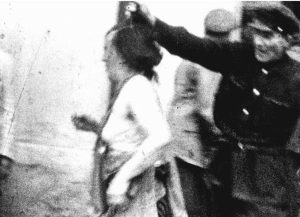
A liberalization period in the 1860s, which granted Jews some privileges was reversed under the May Laws of 1882. These laws restricted Jews in the Pale to urban areas, which were often overcrowded and offered limited economic opportunities. In addition thousands of Jews fell victim to devastating pogroms in the 1870s and 1880s. The pogorms, boycotts and other anti-Semitic depredations Jews faced in the Pale led to mass immigration to the United States (two million between 1881 and 1914). Only after the overthrow of the Czarist regime in 1917 was the Pale of Settlement abolished.

We don't know how our ancestors were affected by this violence but must assume that they weren't spared and that they suffered either directly or indirectly. David Cantor's grandmother was Anna Liroff Kornbleet, Samuel's & Mollie's daughter, and he recalls his grandma's account of a very early memory of hiding in a cellar for several days with her family, at about the age of 2, to escape a pogrom. They subsequently emigrated to England, where they stayed for several years before coming to this country.
Were the pogroms the proximate cause that spurred them on to flee their homeland and seek freedom and peaceful coexistence in America we will likely never know, but leave they did.